
Who must have an energy audit?
Under Article 10 of the Regulation on Increasing Efficiency in the Use of Energy Resources and Energy:
| Who? | Threshold | Audit frequency |
|---|---|---|
| Industrial enterprises | Annual total energy consumption ≥ 1,000 TOE | Every 4 years |
| Commercial and service buildings | Total floor area ≥ 20,000 m² or ≥ 500 TOE | Every 7 years |
| Public buildings | Total floor area ≥ 10,000 m² or ≥ 250 TOE | Every 7 years |
- The audit is carried out by energy efficiency consulting (EVD) companies authorised by the Ministry; if the organisation has an employee with an audit-project certificate who has been on the insured payroll for at least three months, it may carry out the audit itself.
- The final audit report is submitted to the Ministry by the end of March of the year following the audit.
- New buildings carry out their first audit in the 7th year after the occupancy permit; new industrial enterprises in the 4th year after chamber registration.
- Obligation is determined on the basis of the average annual consumption over the last three years.
How is an audit carried out?
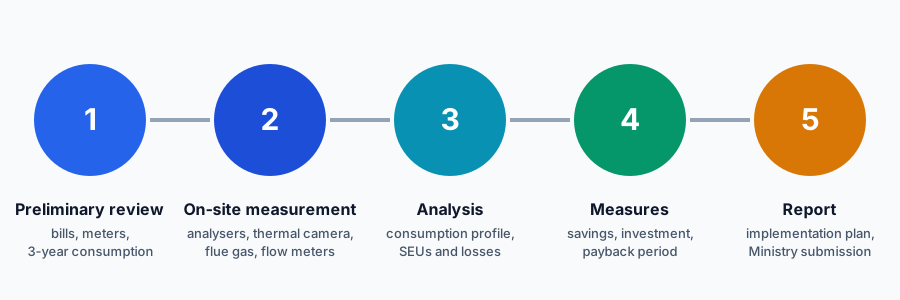
We work within the framework of ISO 50002 and the Ministry's audit report format:
- Preliminary review and data collection: Electricity, natural gas and other fuel bills for the last three years; meter structure, production data, operating hours, equipment lists.
- On-site measurement: Load profiles with power analysers at main distribution boards and large consumers; flue gas analysis on boilers and furnaces; thermal imaging of insulation and electrical connections; flow and temperature measurements; lighting levels.
- Energy consumption profile: Breakdown of consumption by equipment, process and energy type; identification of significant energy uses.
- Savings measures: For each measure, annual energy and cost savings, investment, simple payback period and CO₂ reduction.
- Report and implementation plan: A prioritised roadmap; the audit report to be submitted to the Ministry.
Common savings areas found in audits
Compressed air
Leaks, excessive pressure, idle running and compressor heat that is not recovered.
Electric motors and pumps
Inefficient motors, missing variable speed drives (VSDs) under variable load, incorrect sizing.
Boilers and steam systems
Combustion tuning, condensate return, faulty steam traps, uninsulated valves and pipes.
Waste heat
Using heat from flue gases, furnaces and process water for preheating or space heating.
Lighting
LED conversion, daylight and occupancy sensors, lighting levels matched to need.
Heating, cooling, HVAC
Automation and time schedules, heat-recovery ventilation, chiller and cooling tower optimisation.
Building envelope
Façade and roof insulation, window replacement, thermal bridges.
Electrical infrastructure
Reactive power compensation, harmonics, transformer losses, load imbalance.
Savings potential varies greatly with the age, process and maintenance history of the facility; we give concrete figures only in the report, after measurement.
What does the audit report contain?
- General description of the facility, energy supply structure and meter diagram
- Energy consumption, cost and TOE equivalent for recent years
- Measurement results by equipment and process
- Significant energy uses and energy performance indicators
- Recommended measures: savings, investment, payback period, CO₂ reduction
- Prioritised implementation plan and projects eligible for VAP support
Frequently asked questions
How often must an energy audit be carried out?
Every four years for industrial enterprises consuming 1,000 TOE or more per year; every seven years for commercial, service and public buildings above the thresholds.
Who can carry out an energy audit?
Energy efficiency consulting (EVD) companies authorised by the Ministry of Energy and Natural Resources. If the organisation employs someone with the relevant audit-project certificate who has been insured for at least three months, it can carry out the audit itself.
When is the audit report sent to the Ministry?
The final audit report is submitted by the end of March of the year following the year in which the audit was carried out.
Should a company that is not obliged still have an audit?
For any business with high energy bills, an audit is the fastest way to see which investment will pay for itself in how many years, and it is the basis for support applications such as VAP.