
What is ISO 50001?
ISO 50001 Energy management systems – Requirements with guidance for use is published by the International Organization for Standardization (ISO). The first edition appeared in 2011; the current edition is ISO 50001:2018. The Amd 1:2024 amendment, issued for all ISO management system standards, requires organisations to consider climate change when determining their context. In Türkiye the standard is published by the Turkish Standards Institution as TS EN ISO 50001.
The standard is not a list of savings measures. It is a management framework that makes an organisation regularly ask “who uses energy, where, how much and why?” and set targets based on the answers. It does not impose a fixed savings rate; it requires the organisation to measure its own targets and prove improvements in energy performance with data.
Who must comply?
Under Article 8(2) of the Regulation on Increasing Efficiency in the Use of Energy Resources and Energy, public buildings, commercial buildings, service buildings, power plants and industrial enterprises that are obliged to appoint an energy manager, as well as organised industrial zones and enterprises obliged to set up an energy management unit, must implement TS EN ISO 50001 and have it certified through bodies accredited by TÜRKAK (the Turkish Accreditation Agency). The transition period for this obligation ended at the end of 2023.
- Industrial enterprises with annual total energy consumption of 1,000 TOE or more,
- Commercial and service buildings with a total floor area of at least 20,000 m² or annual consumption of 500 TOE or more,
- Public buildings with a total floor area of at least 10,000 m² or annual consumption of 250 TOE or more.
Below these thresholds ISO 50001 is voluntary, but more and more companies obtain it anyway because of supplier audits by export customers, reporting under the EU Carbon Border Adjustment Mechanism (CBAM) and Ministry support programmes. See our regulations and certificates guide for detailed thresholds.
Structure of the standard: 10 clauses, the PDCA cycle
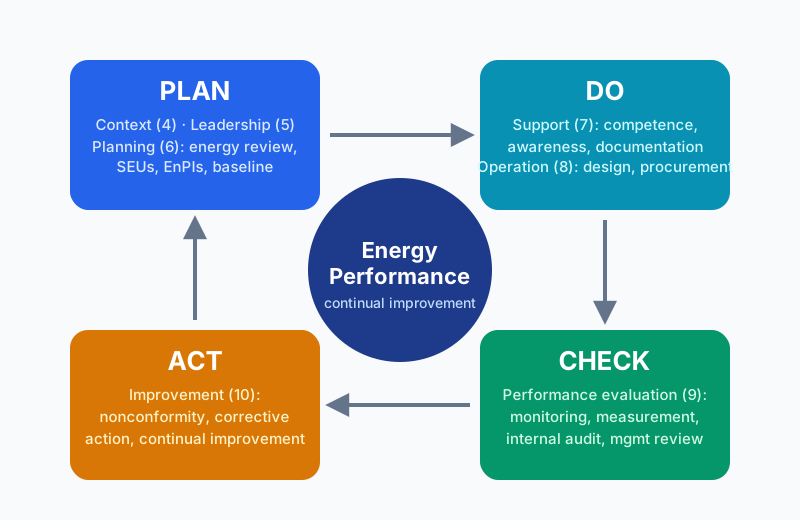
ISO 50001:2018 uses the same Harmonized Structure as ISO 9001, ISO 14001 and ISO 45001, so several management systems can be run as a single integrated system. The requirements are in clauses 4–10 and follow the Plan-Do-Check-Act (PDCA) cycle:
| Clause | Title | What it means in practice |
|---|---|---|
| 4 | Context of the organisation | Internal and external issues, interested parties, legal requirements, scope and boundaries of the system |
| 5 | Leadership | Top management commitment, energy policy, energy management team, roles and authorities |
| 6 | Planning | Risks and opportunities, energy objectives, energy review, EnPIs and energy baseline, data collection plan |
| 7 | Support | Resources, competence, awareness, communication, documented information |
| 8 | Operation | Operational control of significant energy uses, energy-efficient design and procurement |
| 9 | Performance evaluation | Monitoring, measurement, analysis, evaluation of legal compliance, internal audit, management review |
| 10 | Improvement | Nonconformity, corrective action and continual improvement |
Key concepts: SEU, EnPI, EnB
- Energy review
- Analysis of energy sources, consumption and efficiency based on data; the foundation of the system.
- SEU – Significant Energy Use
- Equipment, processes and areas that account for most of the consumption or offer the greatest improvement potential (e.g. compressed air, steam boilers, furnaces, chillers).
- EnPI – Energy Performance Indicator
- The value that measures performance: kWh/tonne of product, kWh/m², Sm³ natural gas/tonne of steam, etc.
- EnB – Energy Baseline
- The reference period against which improvement is compared. It is normalised for relevant variables such as production volume or climate (degree-days), so that lower consumption caused by lower production is not counted as “savings”.
- Energy objectives and action plans
- Measurable objectives, responsibilities, resources and how results will be verified.
The guidance standards ISO 50006 (indicators and baselines) and ISO 50015 (measurement and verification) are used for the methodology.
Our consulting scope: 26 work items
In our ISO 50001:2018 consulting service we carry out the following work together with your organisation:
- Forming the energy team
- ISO 50001:2018 basic training
- Deciding the EnMS scope and boundaries
- Preparing and publishing the energy policy
- Briefing training for top management
- Defining roles, authorities and responsibilities
- A systematic approach to continual improvement
- Internal and external issues affecting energy performance
- Design development that improves energy performance
- Work supporting design activities
- Appointing the authorised persons of the energy management team
- Control of activities and processes affecting energy performance
- Setting energy objectives
- Identifying SEUs (Significant Energy Uses)
- Defining EnPIs (Energy Performance Indicators)
- Establishing the energy baseline
- Collecting energy data
- Identifying resources for continual improvement
- Defining internal and external communication
- Preparing and controlling documented information
- Energy performance of procured equipment and services
- Monitoring, measurement, analysis and evaluation
- Internal audit
- System review at planned intervals (management review)
- Nonconformities and corrective actions
- Preparation for, and attendance at, the certification audit
Implementation schedule: 5 phases
- Phase 1 – Current-state analysis: Forming the energy team, collecting and analysing consumption data for the last three years.
- Phase 2 – Training and documentation: ISO 50001:2018 basic training; preparing the policy, procedures and forms.
- Phase 3 – EnMS set-up and implementation: Putting SEUs, EnPIs, the baseline, objectives and action plans into operation.
- Phase 4 – Internal audit and improvement: Internal audit of the system, closing nonconformities, management review.
- Phase 5 – Certification audit: Audit by an accredited certification body and award of the ISO 50001 certificate.
The duration depends on the size of the facility, its metering infrastructure and data quality; we draw up a schedule for you in the initial meeting where we clarify the scope.
How does certification work?
The certificate is issued by an accredited certification body, not by the consultant. Impartiality rules mean the same organisation cannot both consult and certify. We set up the system, prepare you for the audit and stay with you on the audit days.
- Stage 1 audit: Review of documentation, scope, the energy review and readiness.
- Stage 2 audit: Verification that the system is actually implemented on site and that energy performance has improved.
- Certificate: Valid for 3 years, with annual surveillance audits and a recertification audit at the end of the third year. Audit durations are calculated under ISO 50003 from consumption, number of energy types and number of SEUs.
Tip: To meet the legal obligation, the certification body must hold TÜRKAK accreditation for ISO 50001. You can check accreditation on TÜRKAK's website.
What ISO 50001 brings to your business
- Fulfilment of the obligations under Law No. 5627 and the regulation, removing the risk of administrative fines
- Measurable reduction in energy costs, with savings proven by data
- A strong basis for applications to the Ministry's VAP and efficiency support programmes
- Reliable energy data for carbon footprint, CBAM and sustainability reporting
- An integrated management system with ISO 9001, ISO 14001 and ISO 45001
- Energy performance taken into account in purchasing and investment decisions
Frequently asked questions
Is ISO 50001 certification mandatory in Türkiye?
It is mandatory for companies and buildings that are obliged to appoint an energy manager or set up an energy management unit (for example industrial enterprises consuming 1,000 TOE or more per year). They must have the system certified by a TÜRKAK-accredited body. For other organisations it is voluntary.
How long is an ISO 50001 certificate valid?
Three years. A surveillance audit is carried out every year and the certificate is renewed by a recertification audit at the end of the third year.
Does ISO 50001 certification remove the energy audit obligation?
No. Under the current regulation ISO 50001 does not exempt you from the audit obligation. Industrial enterprises of 1,000 TOE or more must have an audit every four years; commercial, service and public buildings above the thresholds every seven years.
What is the difference between ISO 50001 and ISO 14001?
ISO 14001 is an environmental management system covering all environmental impacts. ISO 50001 focuses only on energy and requires the organisation to prove measurable improvement in energy performance. Both use the same structure and can be implemented together.