
Core legislation
- Energy Efficiency Law No. 5627 (Official Gazette 2 May 2007, No. 26510) – the framework law; administrative sanctions in Article 10.
- Regulation on Increasing Efficiency in the Use of Energy Resources and Energy (Official Gazette 27 October 2011, No. 28097; last amended 21 September 2024, No. 32669) – energy managers, audits, ISO 50001, support programmes.
- Regulation on Energy Performance of Buildings – Energy Performance Certificate and BEP-TR.
- TS EN ISO 50001 Energy management systems standard.
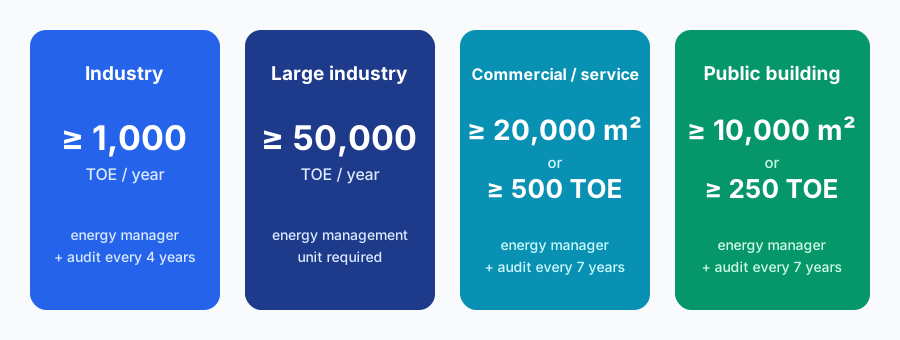
Obligation thresholds
| Organisation | Threshold | Obligations |
|---|---|---|
| Industrial enterprise | ≥ 1,000 TOE/year | Energy manager (own employee), ISO 50001 certificate, audit every 4 years, annual consumption report |
| Industrial enterprise (non-public) | ≥ 50,000 TOE/year | Additionally an energy management unit |
| Commercial and service building | ≥ 20,000 m² or ≥ 500 TOE/year | Energy manager (may be outsourced), ISO 50001, audit every 7 years, annual report |
| Public building | ≥ 10,000 m² or ≥ 250 TOE/year | Energy manager, ISO 50001, audit every 7 years, annual report |
| Organised industrial zone | ≥ 50 operating companies | Energy management unit |
The three-year average is used for the threshold; at new sites the obligation starts immediately if first-year consumption exceeds twice the threshold.
What is a TOE?
TOE (tonne of oil equivalent) is used to add different types of energy together in a common unit. Physically, 1 TOE corresponds to 10⁷ kcal, i.e. about 41.87 GJ (≈ 11,630 kWh) of thermal energy. For the obligation, however, electricity, natural gas, coal, LPG and liquid fuel consumption are converted to TOE using the methodology and conversion factors published on the Ministry's website. Send us your bills and we will calculate your obligation status free of charge.
Certificates: what is each one for?
| Document | Held by | Issued by | Validity |
|---|---|---|---|
| ISO 50001 certificate | Organisation | TÜRKAK-accredited certification body | 3 years, annual surveillance |
| Energy manager certificate | Person | Ministry of Energy and Natural Resources (training + exam) | As set by the Ministry |
| Audit-project certificate (industry / buildings) | Person | Ministry | As set by the Ministry |
| EVD authorisation certificate | Consulting company | Ministry | 5 years, renewable |
| Energy audit report | Facility / building | EVD company or certified staff | Industry 4 years, buildings 7 years |
| Energy Performance Certificate (EKB) | Building | Authorised EKB expert / EVD company (BEP-TR) | 10 years |
If you are going to hire a firm, ask to see the company's EVD authorisation certificate and its staff's certificates.
Annual calendar
- End of March: Annual energy consumption report; final reports of audits carried out in the previous year.
- Throughout the year: Change of energy manager (notification within 15 working days, new appointment within 60 days).
- As announced by the Ministry: VAP and efficiency support applications.
- According to the certificate cycle: ISO 50001 surveillance and recertification audits.
Sanctions
Breaches such as failing to appoint an energy manager, to have an audit carried out or to make the notifications are subject to administrative fines under Article 10 of Law No. 5627. Fine amounts are updated every year by the revaluation rate. Under the regulation, tracking obligation status is the organisation's own responsibility.
This guide is for information only; the legislation was checked on 25 October 2026. The binding texts are those published in the Official Gazette (in Turkish).
Frequently asked questions
Who does Law No. 5627 cover?
It covers industrial enterprises, buildings, power plants, transmission and distribution networks and transport across the generation, transmission, distribution and consumption of energy. Specific obligations arise according to the thresholds in the regulation.
When is the energy consumption report submitted?
Organisations obliged to appoint an energy manager or set up an energy management unit submit their energy consumption data to the Ministry every year by the end of March.